1. Introduction
The present power system spans more than a century and has interconnected the generation stations, transmission networks, and distribution systems
| [1] | R. York and S. E. Bell, “Energy transitions or additions?: Why a transition from fossil fuels requires more than the growth of renewable energy,” Energy Res. Soc. Sci., vol. 51, no. November 2018, pp. 40-43, 2019, [Online]. Available:
https://doi.org/10.1016/j.erss.2019.01.008 |
[1]
. The most popular energy source in the real world, electricity, is used by a number of users in the commercial, residential, industrial, and transportation sectors. It significantly benefits society by offering vital services worldwide. When a power system runs continuously, it is considered to be stable. However, owing to various contingency conditions such as line outage, generator trip, and transformer failures, the running state varies from one operating state to another.
However, ensuring a consistent flow of electricity is crucial for contemporary life. Despite their technical sophistication, power grids are susceptible to disruptions caused by unexpected demand surges and equipment failures. These unexpected incidents, referred to as contingencies (such as lines, generators, and transformers), can lead to voltage instability and cascading outages, resulting in significant economic and social repercussions and potentially plunging the entire region into darkness. To overcome these issues, power system operators may apply intelligence-based load shedding, which involves intentionally reducing the electrical load in the requested load area. This study examined a novel load-shedding strategy that utilizes contingency analysis through the application of MPSO.
The main contributions of this study are as follows:
1) Investigate potential power outages and evaluate how they affect grid stability, particularly voltage stability.
2) Develop an optimization algorithm that utilizes a PSO-based load-shedding strategy to achieve an optimal response to contingency events.
3) Optimize the amount of power for shedding on each load bus.
4) Minimize load shedding requirement while ensuring grid stability (voltage within an acceptable limit).
Generally, this study emphasizes developing and evaluating a PSO-based load-shedding strategy to mitigate the impact of power outage conditions, such as load-increasing conditions, on grid stability, specifically voltage stability.
Researchers have considered various methodologies to establish technical load shedding systems. The following section provides an overview of the diverse approaches used by different researchers. Presented voltage stability for enhancing reliable power systems, particularly post-global blackouts. It mitigates the use of FACTS devices to manage reactive power compensation for rising loads. The authors determined the optimal locations for static var compensators using PV/QV curves and SVS assessments, with simulations conducted using the DigSilent Power Factory simulator
| [2] | N. Manjul and M. S. Rawat, “PV/QV Curve based Optimal Placement of Static Var System in Power Network using DigSilent Power Factory,” 8th IEEE Power India Int. Conf. PIICON 2018, no. July 2020, pp. 1-6, 2018,
https://doi.org/10.1109/POWERI.2018.8704441 |
| [3] | M. S. Geremew, Y. G. Workie, and L. B. Techane, “Identification of System Exposure for the Northwest Region of Ethiopian Electric Power,” Iran. J. Sci. Technol. Trans. Electr. Eng., vol. 0123456789, 2024, [Online]. Available:
https://doi.org/10.1007/s40998-024-00698-x |
[2, 3]
.
Anticipated a new UFLS design that uses power electronics instead of conventional relays to control the load more smoothly. This can improve the efficiency of UFLS by enabling near real-time modifications depending on the frequency deviation index. Through simulations, the authors examined and contrasted these approaches with other UFLS techniques, with a particular emphasis on under-frequency problems
| [4] | Y. Yang and R. Li, “Techno-economic optimization of an off-grid solar/wind/battery hybrid system with a novel multi-objective differential evolution algorithm,” Energies, vol. 13, no. 7, pp. 1-16, 2020, https://doi.org/10.3390/en13071585 |
[4]
.
Pourghasem and Seyedi suggested a novel technique called UVLS to stop voltage collapse in microgrids, which are being utilized more and more as independent power sources. To ensure system stability, the technique ranks and disconnects essential loads using a voltage stability index. The authors used DIgSILENT PowerFactory software to simulate a microgrid using wind, solar, and microturbine power sources in order to test their methodology
| [5] | P. Pourghasem and H. Seyedi, “An under-voltage load shedding scheme to prevent voltage collapse in a microgrid,” Int. Conf. Prot. Autom. Power Syst. IPAPS 2019, no. February, pp. 12-16, 2019, https://doi.org/10.1109/IPAPS.2019.8641952 |
[5]
.
Usman Proposed a UVLS system that reduces load shedding expenses, voltage variation, and power loss. A sophisticated "evolutionary particle swarm optimization" method efficiently establishes the ideal load shedding level. The IEEE-33 bus system was used for testing, and the researchers found that their approach outperformed conventional PSO algorithms in identifying the best answers
.
Cruz Suggested a novel technique for enhancing load curtailment control in medium voltage distribution systems that makes use of particle swarm optimization (PSO). PSO seeks to reduce the necessity of real load shedding. PSO enables effective online control of the load curtailment issue since it is well-suited for real-time deployment. Security limitations based on system element voltage and loading limits are taken into account during optimization
| [7] | L. M. Cruz, D. L. Alvarez, A. S. Al-Sumaiti, and S. Rivera, “Load curtailment optimization using the PSO algorithm for enhancing the reliability of distribution networks,” Energies, vol. 13, no. 12, 2020, https://doi.org/10.3390/en13123236 |
[7]
.
Mogaka examined the effects on islanded microgrids of a substantial incorporation of renewable energy sources. The study uses a standard IEEE 30-bus system on the MATLAB platform to examine both generation and overload issues. The Artificial Bee Colony algorithm is used in the study to maximize load shedding. The outcomes are contrasted with those generated by the GA-PSO hybrid approach, Particle Swarm Optimization, and Genetic Algorithm
| [8] | O. Mogaka, R. Orenge, and J. Ndirangu, “Static Voltage Stability Assessment of the Kenyan Power Network,” J. Electr. Comput. Eng., vol. 2021,
https://doi.org/10.1155/2021/5079607 |
[8]
.
Hafez suggested a novel method for power grids called Under-Frequency Load Shedding (UFLS) that makes use of Multi-Objective Particle Swarm Optimization (MOPSO). In order to create a more reliable and effective UFLS system, MOPSO seeks to minimize load shedding while optimizing the minimum system frequency. Using MATLAB and DIgSILENT PowerFactory software, the researchers evaluated MOPSO against different optimization methods, including adaptive and classic ones, on IEEE bus systems
| [9] | A. A. Hafez et al., “Multi-Objective Particle Swarm for Optimal Load Shedding Remedy Strategies of Power System,” Electr. Power Components Syst., vol. 0, no. 0, pp. 1-16, 2019. |
[9]
.
Even though load shedding and voltage stability augmentation have been studied extensively, existing approaches have a number of drawbacks in high-stress, real-world operating scenarios. Reactive power management is the main goal of approaches that use FACTS devices; however, they lack dynamic adaptability and necessitate expensive infrastructure. Basic threshold-based control is provided by UFLS and UVLS systems; however, they frequently react slowly to sudden spikes in load and do not maximize the quantity or location of load shedding. Although heuristic approaches like basic PSO and Genetic Algorithms (GA) have demonstrated promise in resolving complex power optimization issues, many of these studies either lack multi-objective coordination or fail to consider voltage sensitivity when formulating their solutions. Furthermore, there has been little investigation of region-specific topologies, such as those seen in the Ethiopian grid, and the majority of previous work has been tested on standardized IEEE systems. These shortcomings highlight the necessity of a load-shedding method that is dynamically responsive, sensitive, and computationally efficient in order to meet real-world contingency circumstances.
This study's primary contribution is the creation of a load-shedding method based on Modified Particle Swarm Optimization (PSO) that is specifically intended to improve voltage stability in power systems during emergencies. The suggested approach presents a voltage-sensitivity guided optimization framework that dynamically determines the location and magnitude of real power to be shed across the network, in contrast to traditional strategies that either apply fixed shedding thresholds or optimize without sensitivity coordination. Multi-objective optimization routines that concurrently decrease the overall load shed and restore voltage profiles within allowable operating limits are embedded to accomplish this.
In addition to changing the PSO algorithm, the approach is new because it carefully incorporates voltage sensitivity indices into the fitness assessment procedure, which enables the system to give priority to shedding from buses that have the most stability impact. This allows for targeted, minimal, and quick corrective operations and makes the system extremely sensitive to severe load disruptions. Two major contingency scenarios that are reflective of high-stress grid conditions, 50% and 75% increases in load demand, have been used to evaluate the approach. The algorithm's resilience and usefulness were demonstrated in both situations when it successfully restored the power levels of vital buses like Metema and Gondar. The technique is particularly pertinent for developing power systems with low infrastructural resilience, like those in the Ethiopian grid, because it is computationally lightweight, scalable, and appropriate for real-time or near-real-time implementation. This study thus offers a significant methodological advancement with direct application potential for power system operators, planners, and stability control systems in regions facing volatile demand and constrained infrastructure.
2. Methods and Data Analysis
Ethiopian Electric Power delivers the most recent and significant information on information regarding generator, load, and transmission networks
| [10] | EEP, “Ethiopian Power System Expansion Master Plan Study,” 2014. |
[10]
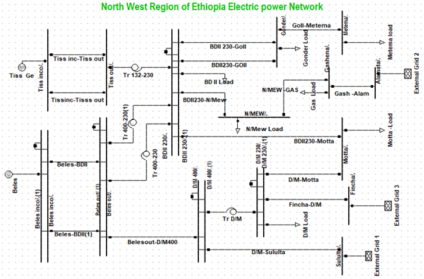
. The Northwest Region transmission system's network diagram is illustrated in
Figure 1 using DIgSILENT PowerFactory software. The assessment of the current condition of the power system typically initiates analysis of Newton-Raphson load flow, centered around a selected area.
Figure 1. Ethiopia's Northwest Electric Power Network.Ethiopia's Northwest Electric Power Network.
2.1. Load Flow Analysis of the System
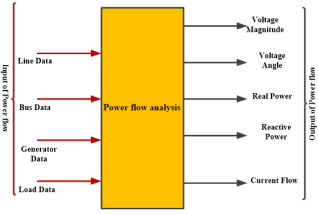
Load flow analysis is probably the most important of all network calculations. Complete information about the examined system, including the rated values of the generator, transformers, lines, and values of each load's actual and reactive power, must be provided to undertake a load flow study as shown in
Figure 2. It is extremely important for all network-related computations because it pertains to the network's performance under steady-state operating conditions.
Figure 2. Load flow analysis.Load flow analysis.
Since load flow is a non-linear problem, one can use any of the following strategies to solve it iteratively: the Newton-Raphson, rapid decoupling, and Gauss-Seidel methods. The Newton-Raphson approach, which has a faster convergence rate and is therefore more applicable to large power systems, is used in this study. The Newton-Raphson method is also a good choice for computer calculations.
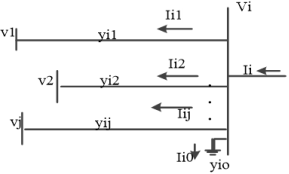
Figure 3 shown below, indicates the net power injected.
Figure 3. Net Power injected.Net Power injected.
The system voltages V and current injection sites I's relationship is described by the nodal network equation that is created, as illustrated in the equation for a network with n buses.
(2)
The values of diagonal elements (Yii) equal the total amount of admittances connected to bus I. The Yij off-diagonal elements are equivalent to the opposite side of the entry between buses I and J. Notably, for large systems, the Y-bus is a sparse matrix.
(3)
As illustrated in
Figure 3, the voltage of the bus (Vi), the surrounding voltages in buses (Vj), and the admittances between the bus and its neighboring buses (yij) can all be used to determine the net injected power at any bus.
The power equation for any bus can be written like this:
(4)
(5)
2.2. Security-Related Functions
To discuss security-related functions, first, it is better to define certain quantities related to power System security
| [11] | A. N. J. B. P. Kundur, Power system stability and control, vol. 7. 1994. |
[11]
.
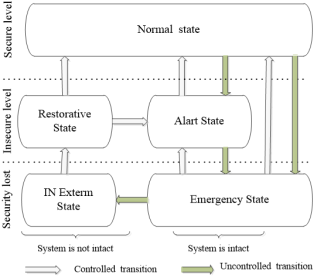
Figure 4 shows the power system's operating state. As it starts from the top down, it is expected that the real-time data provides the current state of the power system.
Figure 4. functioning state of the power system.functioning state of the power system.
Normal State: At this point, no equipment is being overloaded, and all system variables are within their typical range. Such as all bus voltages are within specified limits.
Alert State: If the security level drops below a predetermined threshold for sufficiency. In this state, all system variables are still within an acceptable range, and all constraints are satisfied. Nevertheless, the system has been compromised to the point where unexpected events could result in equipment overload.
Emergency State: The system enters this state when a sufficiently severe disruption occurs in the system. Many buses have low voltage or equipment loads that are higher than the short-term emergency rating.
Restorative State: When all of the system loads are not being satisfied, the power system is in a restorative mode. It suggests a system shutdown, either complete or partial. Restoring system loads as quickly as feasible is the primary goal of this study.
Table 1 outlines the voltage thresholds used to evaluate system security under different operational states. In the alarm state, bus voltages are permitted to deviate slightly from nominal values, with a range of 0.95 to 1.05 p.u., while in the security (emergency) state, the acceptable voltage range is extended to 0.90 p.u. – 1.10 p.u. These thresholds serve as critical indicators for system operators to identify the onset of instability and to initiate remedial measures, like load shedding, before the system transitions into an emergency or restorative state.
Table 1. Alarm and security limits.Alarm and security limits.Alarm and security limits.
Parameters | Alarm limit | Security limit |
Voltage of the bus (lower) (P.u) | 0.95 | 0.9 |
Voltage of the bus (upper) (P.u) | 1.05 | 1.10 |
2.3. Analysis of Stability for Electrical Power Systems
Electrical power system stability is the electrical power system’s ability to return to a balanced condition after disturbance
. The capacity and load of the electrical system will fluctuate at any time as it operates. The generator had to modify its ability to produce load power as a result of that adjustment, using the governor and excitation control.
2.3.1. Stability of Voltage
Voltage stability is the ability of the power system to keep each bus's voltage stable in the wake of a disturbance
| [13] | S. S. Refaat, H. Abu-Rub, A. P. Sanfilippo, and A. Mohamed, “Impact of grid-tied large-scale photovoltaic system on dynamic voltage stability of electric power grids,” IET Renew. Power Gener., vol. 12, no. 2, pp. 157-164, 2018,
https://doi.org/10.1049/iet-rpg.2017.0219 |
| [14] | M. S. Geremew, Y. G. Workie, J. N. Kamau, M. Bajaj, and L. B. Techane, “Voltage Stability Enhancement in North West Ethiopia ’ s Power Grid Using Contingency Analysis and PSO-Based Load Shedding,” vol. 11, no. 3, pp. 41-58, 2025,
https://doi.org/10.11648/j.ajme.20251103.11 |
[13, 14]
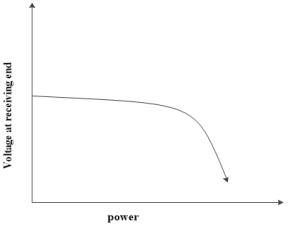
. The primary reason why voltage instability occurs is unbalanced reactive power. This imbalance primarily manifests itself in a system's local bus or local network. As a result, there must be enough local reactive power support. As demonstrated in
Figure 5 below, as the PV curve of power versus power rises, the voltage at the power transfer's receiving end falls. Apply voltage sensitivity analysis with the UVLS approach to enhance these voltage profiles.
Figure 5. A power vs voltage plot.A power vs voltage plot.
2.3.2. Computational Intelligent Load Shedding
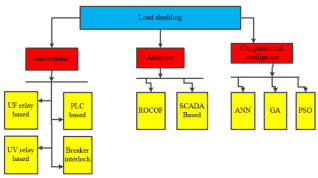
Load shedding is a protection scheme used in a power system to avoid the condition of overloading during a large disturbance. It can alter the power usage of a certain load bus and help to prevent system instability. Numerous researchers have created various load-shedding and restoration techniques, including conventional, adaptive, and computational, as shown in
Figure 6.
Figure 6. Categorization of load-shedding methods.Categorization of load-shedding methods.
An intelligent load-shedding scheme takes into account the operating conditions before and after a disturbance, its nature, duration, the system's transient reaction to the disturbance, and the mode of users online. For extremely non-linear issues, techniques like neural networks, genetic algorithms, particle swarm optimization, simulated annealing, fuzzy logic, and others provide efficient problem-solving, knowledge representation, planning, and action
| [15] | H. Haes, M. Esmail, H. Golshan, T. Cuthbert, and N. D. Hatziargyriou, “An Overview of UFLS in Conventional, Modern, and Future Smart Power Systems : Challenges and Opportunities,” Electr. Power Syst. Res., vol. 179, no. February 2019, p. 106054, 2020,
https://doi.org/10.1016/j.epsr.2019.106054 |
[15]
. In this condition, the mode of utilization is online.
2.3.3. Load Shedding
To make the system more functional when there are low voltage conditions, load shedding is set up. Systems that have had a disturbance may remain stable after the disturbance, although bus voltages are still low. Systems that have had a disturbance may remain stable after the disturbance, although bus voltages are still low. When voltages are too close to stability limits, collapse can occur suddenly and easily, even with voltage adjustment techniques.
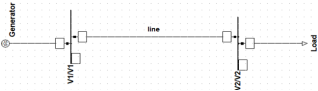
Therefore, during a disturbance, the voltage may begin to fall below acceptable levels. Calculating the total power differential between the before and after conditions is the first phase of the procedure. Once the size of the disturbance has been determined, the position and the amount of load to be shed from the load bus must be decided. The next step is to calculate how much load each bus should be able to handle. The voltage sensitivity of each bus determines that. Assume that there is a single generator, transmission line, and load in a two-bus system as depicted in
Figure 7 to explain sensitivity analysis.
Figure 7. Model representation of two buses.Model representation of two buses.
The equations are as follows when further simplified for a two-bus system:
(6)
The power delivered at the receiving end is now PD = -P12 and QD = -Q12. This only applies to two-bus systems; a larger system would follow a different set of steps. After the formula between QD and V2 has been formed, the previous equation can be differentiated, Eq. (
6). We get,
(7)
The generalized equation for the n-bus system is,
(8)
The dQ/dV relation can be expressed as follows for each bus separately:
(9)
if load bus X's dQ/dV value is greater than load bus Y's dQ/dV value. Therefore, a higher load must be released from lower levels of dQ/dV. Thus,
To assess this load quantity, take the reciprocal of the voltage sensitivity as a percentage of the total reciprocal of the voltage sensitivities.
(11)
For each bus, the equation above provides a value that is fractional for the voltage sensitivity. The amount of load that needs to be shed, as well as the dV/dQ value at every bus, is now directly related.
The aggregate of all the buses' dV/dQ values is now,
(12)
The equation above adds together the dV/dQ values at each load bus. In order to keep the power balance, less load must be discharged overall than at each bus. The fraction of the dV/dQ value at each bus that corresponds to the previously calculated total is the load percentage at each bus. This is shown as
(13)
This represents a fraction of all voltage sensitivity. Therefore, the load that each bus must drop is determined depending on the bus's proximity to the knee point when this percentage is multiplied by the entire load that needs to be shed.
The empirical formula that will be examined is;
(14)
This equation determines the necessary power shedding for each load bus during load conditions. This calculation provides a precise value for the power that needs to be shed at each location. It is done by leveraging Equation (
13), the voltage sensitivity factor of the bus, and multiplying it by the power difference (Pdiff) at each bus. This calculation provides a precise value for the power that needs to be shed at each location.
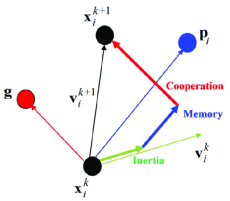
2.3.4. Particle Swarm Optimization
PSO was introduced by Kennedy and Eberhart in 1995
| [9] | A. A. Hafez et al., “Multi-Objective Particle Swarm for Optimal Load Shedding Remedy Strategies of Power System,” Electr. Power Components Syst., vol. 0, no. 0, pp. 1-16, 2019. |
[9]
. PSO is a member of the class of swarm intelligence approaches designed to address large-scale non-linear optimization issues. The social behavior of animals, such as fish schools and flocks of birds, served as its inspiration. PSO is a powerful meta-heuristic search technique.
PSO has the following benefits over other artificial intelligence systems
| [16] | S. Acharya, I. Sahoo, J. Senapati, A. Agarwal, P. Mishra, and R. K. Dash, “Performance Analysis of the PSO Algorithm: An Experimental Study,” SSRN Electron. J., no. January, 2021,
https://doi.org/10.2139/ssrn.3850129 |
[16]
: PSO uses competition and teamwork to decide on the next step's direction. Compared to the simulated Annealing method and the Genetic Algorithm method, fewer parameters need to be set. The complexity of the objective functions has less of an impact on PSO's calculation time. The overall graphical representation of PSO is shown in
Figure 8 below.
Figure 8. Graphical Illustration of the PSO Algorithm.Graphical Illustration of the PSO Algorithm.
(15)
2.4. Problem Formulation
The following are the two primary goals of the under-voltage shedding system:
To reduce the overall load shed on the chosen buses.
To minimize voltage drops at all buses.
This optimization problem can be formalized as follows.
2.4.1. Objective Function
(17)
The equation represents the multi-objective function for power shedding in the load bus and voltage profile change. The optimization algorithm determines the amount of power shedding by minimizing the objective functions.
Where f1 and f2 are the objective functions used to identify the power shed for each bus and voltage profile change, respectively. The proposed strategy aims to minimize the load shedding value while optimizing the power system's voltage stability.
The following mathematical formulation of f1 and f2, listed in equation (
18), is used to define the individual objective function. This is crucial for voltage stability and load shedding when using the PSO algorithm.
(18)
2.4.2. Constraints
The optimization issue requires consideration of both equality and inequality constraints.
1) Equality Constraints
Equations for the balance of reactive and real power can be expressed in equality constraints.
(19)
2) Inequality Constraints
The minimum and maximum bus voltage magnitude, real, and reactive power range during generation bus injection are the inequality constraints.
(20)
2.5. Load Shedding Algorithm of Particle Swarm Optimization
Step 1: For a power outage, use the complete A. C. Newton-Raphson power flow.
Step 2: Find out the load bus's sensitivity factor.
Step 3: Consider the sensitivity factors and then calculate the rate of disturbance that will occur in each bus.
Step 4: Construct a population of randomly generated particles as a reference point.
Step 5: Fitness determines each particle's fitness.
Step 6: By comparing each particle's current pbest fitness, update each particle's individual best solution (pbest).
Step 7: Update the new particle positions and velocities using equations (
15) and (
16).
Step 8: Find the updated global best solution by evaluating each particle's new fitness value in light of its changed position and velocity. Additionally, modify the Pbest and Gbest values.
Step 9: Generate a new population.
Step 10: Until the convergence condition is met, go to step 7.
Step 11: Stop the simulation.
3. Outputs and Discussion
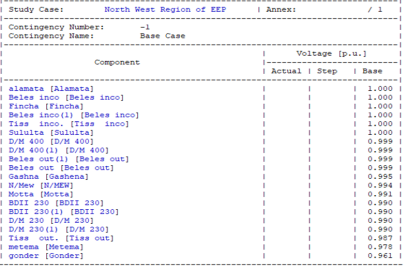
3.1. The simulation's Base Case Value
With just three iterations, the Newton-Raphson load-flow simulation was gathered. Nevertheless, the network's power flow analysis operates under many circumstances.
As depicted in
Figure 9, the voltage magnitude for each bus remains within the normal range under standard conditions, indicating no voltage violations. However, certain buses may experience a decrease in voltage profile below their limits during transitions from emergency to extreme states and from alert to emergency within the power system. This can be attributed to fluctuations in load or line disconnections. Consequently, conducting a contingency analysis becomes crucial to address potential security concerns.
Figure 9. Each bus's voltage violations in the base.Each bus's voltage violations in the base.
3.2. Scenario 1: Each Bus's Voltage Profile Under Loading Conditions
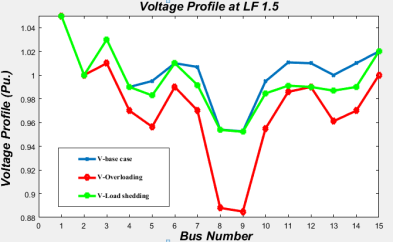
3.2.1. Simulation Result of Bus Voltage violations Before, During, and After the Load Shedding System for a 1.5 Load Factor
Table 2 and
Figure 10 show the load bus's voltage profile data before, during, and after the load-shedding process. In a typical scenario, load buses 8 and 9 have voltage profiles of 0.978 and 0.961 per unit, respectively, as shown in the figure below. But with a 50% state of rising load, their voltage profile has decreased to 0.888 and 0.885 voltage per unit. The deviation in voltage profiles for Metema and Gondar load buses compared to others can be attributed to their longer distance from the generation station to the load center and their high loading rates. This underscores the significant impact of unplanned load variations on each load bus's unique voltage profile. However, its voltage profile restored to normal after load shedding was implemented.
Table 2. Bus voltage of the 15 bus system in Normal, during contingency (Load Factor 1.5), and after load shed.Bus voltage of the 15 bus system in Normal, during contingency (Load Factor 1.5), and after load shed.Bus voltage of the 15 bus system in Normal, during contingency (Load Factor 1.5), and after load shed.
Voltage in per unit |
Bus No | Bus name | Normal base | During loading (50%) | Load shed for 50% By PSO |
1 | Belesin | 1.000 | 1.0500 | 1.0500 |
2 | Tissin | 1.000 | 1.0000 | 1.0000 |
3 | Belesout | 0.999 | 1.0100 | 1.0300 |
4 | Tissout | 0.987 | 0.9700 | 0.9900 |
5 | BDII230 | 0.991 | 0.9564 | 0.9829 |
6 | D/M400 | 0.999 | 0.9900 | 1.0100 |
7 | D/M230 | 0.990 | 0.9702 | 0.9917 |
8 | Metema | 0.978 | 0.8879 | 0.9538 |
9 | GOII | 0.961 | 0.8849 | 0.9523 |
10 | N/Mew | 0.994 | 0.9549 | 0.9846 |
11 | Gashena | 0.995 | 0.9859 | 0.9911 |
12 | Alamata | 1.000 | 0.9900 | 0.9900 |
13 | Motta | 0.994 | 0.9610 | 0.9869 |
14 | Fincha | 1.000 | 0.9700 | 0.9900 |
15 | Sululita | 1.000 | 1.0000 | 1.0200 |
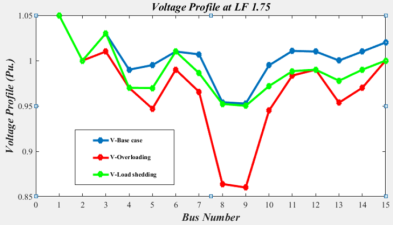
3.2.2. Simulation Result of Bus Voltage Violations Before, During, and After the Load Shedding System for a 1.75 Load Factor
Table 3 and
Figure 11 show the load bus's voltage profile results before, during, and after the load-shedding process. As observed in
Figure 11, the voltage profile of load bus 8 and load bus 9 in a normal case is 0.978 and 0.961 per unit, respectively. But with a 75% load-increasing condition, their voltage profile has decreased to 0.863 and 0.860 voltage per unit. The reason why the voltage profiles of Metema and Gondar load buses are lower than those of others. Because of their longer distance from the generation station to the load center and their high loading rates. This underscores the significant impact of unplanned load variations on the voltage profiles of individual load buses. But after taking load-shedding action, its voltage profile returned to normal condition.
Table 3. Bus voltage of 15 bus systems in Normal, during contingency (1.75 Load Factor), and after load shed.Bus voltage of 15 bus systems in Normal, during contingency (1.75 Load Factor), and after load shed.Bus voltage of 15 bus systems in Normal, during contingency (1.75 Load Factor), and after load shed.
Voltage in per unit |
Bus No | Bus name | Normal base | During loading (75%) | Load shed for 75% By PSO |
1 | Belesin | 1.000 | 1.0500 | 1.0500 |
2 | Tissin | 1.000 | 1.0000 | 1.0000 |
3 | Belesout | 0.999 | 1.0100 | 1.0300 |
4 | Tissout | 0.987 | 0.9700 | 0.9700 |
5 | BDII230 | 0.991 | 0.9469 | 0.9697 |
6 | D/M400 | 0.999 | 0.9900 | 1.0100 |
7 | D/M230 | 0.990 | 0.9655 | 0.9862 |
8 | Metema | 0.978 | 0.8638 | 0.9522 |
9 | GOII | 0.961 | 0.8600 | 0.9501 |
10 | N/Mew | 0.994 | 0.9449 | 0.9719 |
11 | Gashena | 0.995 | 0.9835 | 0.9884 |
12 | Alamata | 1.000 | 0.9900 | 0.9900 |
13 | Motta | 0.994 | 0.9536 | 0.9777 |
14 | Fincha | 1.000 | 0.9700 | 0.9900 |
15 | Sululita | 1.000 | 1.0000 | 1.0000 |
Figure 11. Magnitudes of voltage (PU) base case, load, and Shedd at LF 1.75.Magnitudes of voltage (PU) base case, load, and Shedd at LF 1.75.
3.3. Scenario 2: Load Bus Real Power Magnitude During Loading Condition
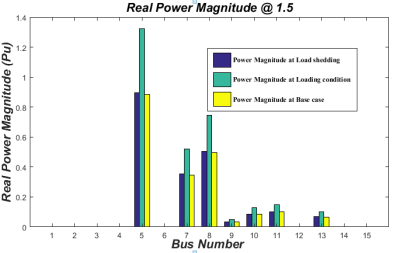
3.3.1. Load Bus Real Power Magnitude Before, During, and After the Load Shedding System for a 1.5 Load Factor
In the conducted test system, comprising 2 generators, 15 buses, and 15 transmission lines, the load-shedding technique focuses primarily on managing load variability at the load bus. The methodology involves inducing loading on the load bus, followed by the application of load shedding to determine how much power each load bus needs to be reduced.
The outputs and discussion present
Table 4 and
Figure 12, illustrating the load bus's actual power magnitude in normal conditions, during contingency, and after executing the load-shedding system. When the demand for the load bus increases by 50%, the bus's real power magnitude is trending increasing. However, following the load-shedding intervention, the real power magnitude of the load bus experiences a decrease. As shown in
Table 4, the BDII230 load bus typically has a load of 0.8823 per unit. However, the load increased by 50% its real power magnitude was updated from 0.8823 to 1.3235 per unit. But after taking load shedding action real power magnitude decreased from 1.3235 to 0.8958 per unit. Similarly, the remaining load bus has decreased by such an amount of power.
Table 4. Real power of the load bus in normal, during contingency (1.5 Load Factor), and after load shed.Real power of the load bus in normal, during contingency (1.5 Load Factor), and after load shed.Real power of the load bus in normal, during contingency (1.5 Load Factor), and after load shed.
Load power in per unit |
Load Bus No | Bus Name | Normal case (MW) | During loading(50%) (MW) | Load shed for 50% PSO(MW) |
5 | BDII230 | 0.8823 | 1.3235 | 0.8958 |
7 | D/M230 | 0.3468 | 0.5202 | 0.3521 |
8 | Metema | 0.4981 | 0.7472 | 0.5057 |
9 | GOII | 0.0340 | 0.0510 | 0.0345 |
10 | N/Mew | 0.0847 | 0.1271 | 0.0860 |
11 | Gashena | 0.1000 | 0.1500 | 0.1015 |
13 | Motta | 0.0667 | 0.1001 | 0.0667 |
Figure 12. Load power (PU) base case, load, and Shedd at LF1.5.Load power (PU) base case, load, and Shedd at LF1.5.
3.3.2. Load Bus Real Power Magnitude Before, During, and After the Load Shedding System for a 1.75 Load Factor
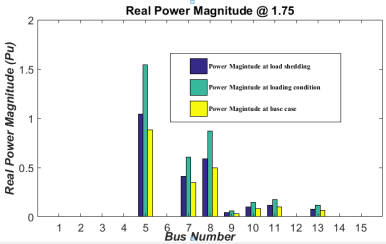
The results and discussion present
Table 5 and
Figure 13, illustrating the load bus's actual power magnitude in normal conditions, during emergencies, and after executing the load-shedding system. When the demand for the load bus increases by 75%, the bus's real power magnitude is trending increasing. However, following the load-shedding intervention, the real power magnitude of the load bus experiences a decrease. As shown in
Table 5, the BDII230 load bus typically has a load of 0.8823 per unit. However, the load increased by 75%, and its real power magnitude was updated from 0.8823 to 1.5440 per unit. But after taking load shedding action real power magnitude decreased from 1.5440 to 1.0451 per unit. Similarly, the remaining load bus has decreased by such an amount of power.
Table 5. Real power of the load bus in normal, during contingency (1.75 Load factor), and after load shed.Real power of the load bus in normal, during contingency (1.75 Load factor), and after load shed.Real power of the load bus in normal, during contingency (1.75 Load factor), and after load shed.
Load power in per unit |
Load Bus No | Load Bus Name | Normal case (MW) | During loading (75%) MW | Load shed for 75% PSO(MW) |
5 | BDII230 | 0.8823 | 1.5440 | 1.0451 |
7 | D/M230 | 0.3468 | 0.6069 | 0.4108 |
8 | Metema | 0.4981 | 0.8717 | 0.5900 |
9 | GOII | 0.0340 | 0.0595 | 0.0403 |
10 | N/Mew | 0.0847 | 0.1482 | 0.1003 |
11 | Gashena | 0.1000 | 0.1750 | 0.1183 |
13 | Motta | 0.0667 | 0.1167 | 0.0790 |
Figure 13. Load power (PU)base case, load, and Shedd at LF 1.75.Load power (PU)base case, load, and Shedd at LF 1.75.


Author Contribution
Mebratu Sintie Geremew: Conceptualization, Data curation, Formal Analysis, Investigation, Methodology, Resources, Software, Supervision, Visualization, Writing original draft, Writing – review & editing
Yalew Gebru Werkie: Conceptualization, Data curation, Formal Analysis, Investigation, Methodology, Resources, Software, Supervision, Visualization, Writing original draft, Writing – review & editing.
Joseph Ngugi Kamau: Formal Analysis, Supervision, Validation, Visualization, Writing – original draft, Writing review & editing
Churchill Otieno Saoke: Formal Analysis, Supervision, Validation, Visualization, Writing – original draft, Writing review & editing
Dessalegn Bitew Aeggegn: Formal Analysis, Supervision, Validation, Visualization, Writing – original draft, Writing –review & editing
Gedef Yigalem Sharie: Formal Analysis, Supervision, Validation, Visualization, Writing – original draft, Writing –review & editing